
Submit Your Questions
Have you got a question about Swim Team you'd like answered? A helpful tip you'd like to share? Use our Contact Us page to submit and we will answer your question or post your tip on this page.


Finding your volunteer roles?
Signed up for jobs during registration and can't remember? No worries!
Just "login" at the top right of the www.bcwbarracudas.com web page. Then go to "My Account". You will be able to find your volunteer roles on that page.
The job info will also be available on the Season Info → Swim Meets & Events page as we get closer to the events.
Age Group Parents
The BCW Swim Meets 101 presentation provides an excellent overview of our pool layout, summarizes our meet operations, and answers some common questions.
If you are volunteering as an Age Group Parent, please read below.
Age Group Parents (AGP) need to be present 15 minutes before warm-ups begin (typically 1 hour 15 minutes before home meets and 45 minutes before away meets) and stay until each swimmer in their age-group has been collected by their parents at the end of the meet. These volunteers are responsible for checking that their swimmers are all present and communicating any no-shows to the AGP Lead so we can find appropriate relay replacements.
While we ask parents to mark their kiddos’ arms with their events before they arrive, the AGP can do that if they forgot. AGPs also get swimmers ready to move to the Ready Bench for each race throughout the meet.
Getting Started
When you arrive, check in, get a clipboard (with heat sheets), marker, and lanyard from the AGP Lead and identify the location of the computers and ready bench. Go to the section identified for your age group and start checking off the swimmers as they arrive and confirming they have their events marked on their arms (see below for how to mark up a swimmer). Try to do this before they start warm-ups and before they apply sunscreen (Sharpies don’t write well on wet arms or after sunscreen). Make sure each swimmer has signed in at the swimmer sign in table first!
At least 15 minutes before the meet begins, confirm all swimmers in your group have arrived. If someone has not shown up, notify the AGP Lead so they can find an eligible swimmer for any relays. If a swimmer does not show up for a relay during the meet, notify the Relay Coordinator (or the AGP Lead if there isn’t one) to find an eligible swimmer — do not just find a substitute on your own.
Heat Sheets
Heat sheets list all the swim events, along with the participants in each event, what heat they are in, and what lane they are in. They will be posted here https://www.bcwbarracudas.com/swim_meets and you will be given a printed copy of the current heat sheet the morning of the meet, as well as a check in summary sheet for each child in the age group. Use that one since there may be last minute changes. Heats are typically organized from slowest to fastest seed times (the fastest time the swimmer previously posted in that event). If a kiddo is swimming an event for the first time, the heat sheet will have NT for "no time."
During the Meet
During the Meet, it is the Age Group Parents’ job to help organize the kids in his/her group before each event and send them in line in heat order to the ready bench. Keep an eye on the board showing the events and the groups ahead of you so you can line up the swimmers in your group to send them to the ready bench when there are about 10 heats from their event. Your group should line up in front of the kiddie pool when the group ahead of them moves off the pool deck line and onto the ready benches.
The kids swimming the current event will be lined up by heat/lane in the chairs behind the pool (at BCW), with the swimmers in the next event(s) on the ready benches and the swimmers in the following event lined up and ready to go to the ready benches when they are cleared. This keeps the swim meet flowing smoothly. For more information on how this works, check out the Swim Meets 101 presentation.
End of the Meet
Kids will start to drift off to find their parents after their last event, but remind them to be sure to stay if they are in one of the late relays. If they are not, it is still nice for them to stay to cheer on their teammates and to be available in case there’s a scratch.
Encourage the kids to CLEAN UP their area. Every kid should throw away at least two pieces of trash. Kids should also collect their own belongings like wet towels, chairs, goggles, caps, etc. The lost and found is usually overflowing after swim meets.
Return the clipboard, lanyard and sharpies to the sign-in table and take a deep breath. You did it!
How to Mark Up a Swimmer
While it is helpful if parents mark up their kids before arriving at the meet, some will forget or the events may have changed. When you check in each child in your group, confirm they are marked with their name on their backs. Marking events on their arms is completely optional and for younger kids, it may be easiest to just put the event number and stroke so they can quickly glance down to see whether they are in an event (e.g. #19 - Free).
Here’s a helpful video: https://www.youtube.com/watch?v=ww3fElqOh6o
If you want to write the events, here are the basic steps and more detail can be found at: https://docs.google.com/document/d/1yqtIbSkH7KXWMW0xW2Wo2Gm8X2hBf87tVsQqX1X2be8/edit?usp=sharing
- Write your swimmer's name in big letters on his/her back.
- Go through the summary sheet for each child, confirming their events.
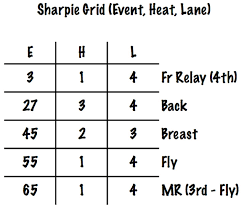
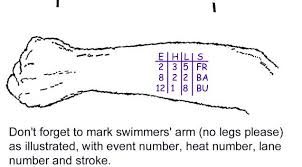
- Make four (4) column headings - E, H, L, S on your child’s left forearm (grid lines optional). These stand for Event, Heat, Lane and Stroke
- For each event, write the event number, heat number, lane number and stroke in the corresponding column.
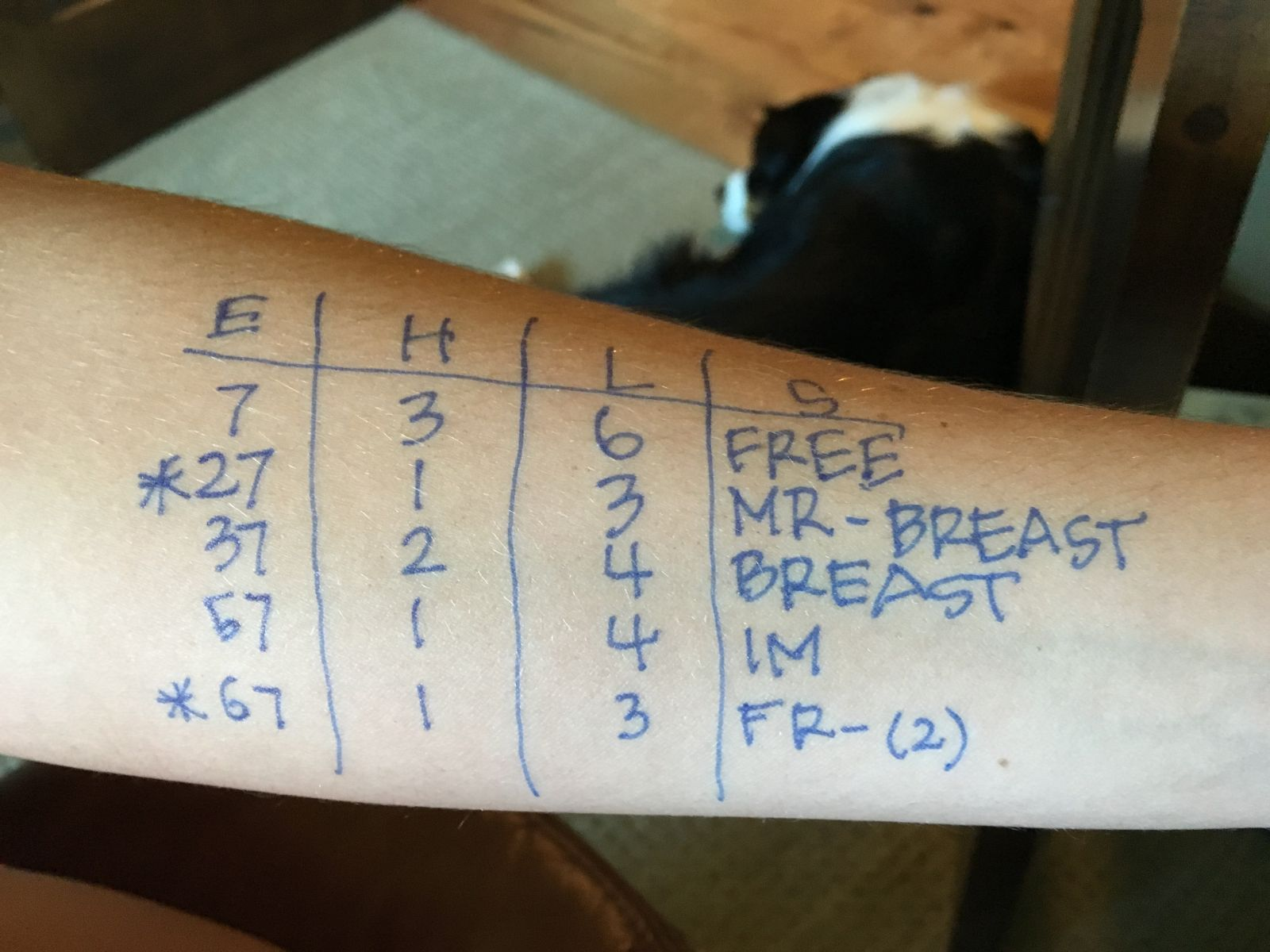
The * asterisk that is marked on the left of numbers 27 and 67 in the picture above indicates that those are relays (see relay marking below).
Strokes: You can use the following abbreviations for the strokes:
- F = Freestyle
- BK = Backstroke
- BR = Breaststroke
- FLY = Butterfly
- IM = Individual Medley (Same swimmer swims all 4 strokes in this order: Fly, Back, Breast, Free)
- FR = Free Relay (All swimmers swim freestyle)
- MR = Medley Relay (Each swimmer swims a different stroke: 1st = back, 2nd=breast, 3rd=fly, 4th=free)
Relays
- Swimmers may swim in a max of two (2) relays per meet (one free relay and one medley relay).
- On any relay team, there must be at least one swimmer from that age group on the relay.
- Younger swimmers may swim up in older age groups for relays; however, that counts toward their number of allowed relay swims and those swimmers may only swim a max of two relays per meet (one free relay and one medley relay).
Relay Marking: This will designate the relay leg the child is swimming.
- 1/1 = Lane 1, first relay leg
- 4/2 = Lane 4, 2nd relay leg **If the Medley Relay this will be Breaststroke
The Medley Relay (MR) order is as follows:
1 – BK 2 – BR
3 – FLY 4 – FREE
The Freestyle Relay (FR) is displayed in the same order as the Medley Relay.
All swimmers in the FR swim FREESTYLE but they are put in an order of how they should swim:
1 – FREE 2 – FREE
3 – FREE 4 – FREE
About Those Relays...
Relays are a constant source of questions from parents. How are they formed? How do I know if my child is swimming? Does my child have to swim relays? We hope this FAQ answers all of these and more.
Relays reflect the “team” in swim team — a chance to compete together toward a shared goal. Most importantly, they’re really fun, and they’re meant to be! They build team spirit and help kids feel a real partnership with their fellow Barracudas.
Being placed on a relay is a privilege, and it sometimes means stepping outside a personal comfort zone for the good of the team. For example, a swimmer might be asked to:
- Swim up to an older age group to complete a team
- Welcome a much younger swimmer to complete their team
- Swim a less-favored stroke to build the fastest team
- Swim on a relay apart from specific friends
- Arrive early or stay late to help avoid a scratch for teammates depending on them
Please read through the information below to better understand how these awesome events work.
What kinds of relays do we swim at meets?
There are two types of relays we swim at meets, though some meets may be exceptions. Always check the meet entry details carefully for changes to the events and order before entering.
1. Medley Relay (ages 7 and above). Four kids each swim a different stroke for one length of the pool, in this order: Backstroke (1), Breaststroke (2), Butterfly (3), Freestyle (4). Check the heat sheet to see when the event is held and which swimmer swims which stroke.
- In most meets, these are usually events #11–#18 on the heat sheet.
- Swimmers MUST have a current, legal time in a stroke to swim that stroke in the medley relay. The computer will not pull a swimmer into a stroke they don’t have a valid time in.
- Stroke assignment is done by the computer to create the fastest possible teams. Anyone selecting the medley relay should be prepared to swim any stroke they have a qualifying time in — requests to change or prefer a stroke are not considered.
- Note: the medley relay stroke order differs from the Individual Medley (IM), in which one swimmer swims each stroke in this order: Butterfly, Backstroke, Breaststroke, Freestyle.
2. Freestyle Relay (all age groups). Four kids each swim freestyle for one length of the pool.
- In most meets, these are events #9 and #10 for ages 6 and under, and events #59+ for ages 7 and above.
- Almost all swimmers are eligible for a freestyle relay team.
- Swim-ups, intrasquad programs, or other meet logistics may shift the order, so always check the meet entry details.
How are relay teams formed?
Relays are computer-generated by fastest time, and our coaches evaluate and adjust if needed. Each meet’s relays are built from swimmers’ previously recorded times at official AHSL meets, following AHSL guidelines, to form the fastest teams from the swimmers available at that meet in that age group. Coaches sometimes make slight adjustments in the best interest of an age group or the overall team, but individual preferences — other than no swim-ups and availability — don’t factor into those adjustments.
At most meets we can form 2–3 relays per age group; most dual meets are limited to 3 per age group per team, and tri-meets to 4. So if there are more than 12 kids in an age group (and many of our younger groups are very large), not all of them will be in a relay. Our goal is to get as many kids into relays as possible — which may also mean your child is asked to swim with older kids to fill out a team.
How do I RSVP properly for relays?
When signing up for a meet you plan to attend, you have four options for relays:
- Attending and available for ANY relays (willing to swim both)
- Attending, but cannot swim EARLY relays (i.e., arriving late)
- Attending, but cannot swim LATE relays (i.e., leaving early)
- Attending, but cannot swim ANY relays (not willing to swim either)
Note that the RSVP “lingo” is based on your timing schedule, NOT the type of relay, since that can change by meet. Depending on age group:
- For ages 7 and above, “early relays” usually means the medley relay and “late relays” usually means the freestyle relay.
- For ages 6 and under, the 6 & Under freestyle relay comes early in the meet, so it counts as an “early relay.” Young swimmers may also be asked to swim up into a later relay for an older age group (see swim-ups below). If you need to leave early, choose “Attending, but cannot swim LATE relays” (or check “No swim-ups requested”) so the Relay Coordinator knows not to place your swimmer in a later relay.
If you’re unsure whether your swimmer will be able to attend for any reason, PLEASE sign up for individual events only and choose NO RELAYS. You can always withdraw from individual entries with minimal disruption, and you’ll still be able to participate if you end up available. Missing a relay, on the other hand, creates a domino effect of heat-sheet changes affecting the Relay Coordinator, AGPs, Ready Bench, and Computer volunteers — and most importantly, a scratched relay can leave three or more teammates disappointed on the side of the pool.
Why isn’t my swimmer in a relay if we marked “available”?
“Willing to swim” doesn’t always mean “will swim.” It means your child is available — and there are often more swimmers than open relay spots. We try to include as many happy, swimming Barracudas as we safely can each season, so some age groups have many more members than the usual 12 relay spots. Don’t be daunted if you don’t make those relays right away; we have other opportunities that can help.
What are “swim-ups” and how do they work?
A swim-up is when a younger swimmer joins an older age group’s relay to complete the team and avoid a scratched race. Our team can often use swim-ups to move kids from younger, large rosters into older, less-populated age groups. As long as one of the four spots is filled by a swimmer in that age group, we can fill the rest with willing Barracudas.
A younger swimmer might feel daunted to be with “the big kids,” but those older swimmers really appreciate the bravery of stepping up to complete a team that would otherwise scratch. Most of our older swimmers remember swimming up themselves, so it’s a great community-building part of our team.
Still, if your swimmer is uncomfortable with a swim-up, check the “No swim-ups requested” box during each meet’s RSVP, and the computer will only consider them for a relay in their own age group. This has no bearing on placement within their own age group’s relays, but it does lower their overall relay chances by limiting the other spots available to them.
How can I be a good relay teammate? (aka the RULES stuff)
BE COMMUNICATIVE
First, RSVP properly for each meet according to your schedule. If a meet falls during a possible dance callback or baseball tournament, select “Attending, no relays” when you RSVP — don’t create churn for our volunteers over foreseeable conflicts. If things work out and your swimmer wants to change their availability, they can simply tell the Athlete Check-in volunteer or Relay Coordinator when they sign in on time at the start of the meet.
If something unforeseeable happens after the RSVP deadline — illness, injury, or another non-scheduling issue — for a meet your swimmer was marked available for, please email [email protected] as soon as you safely can, so the volunteer team has as much lead time as possible. We understand that life happens and appreciate any notice you can give.
BE ON TIME
Perhaps the most important rule: if you’re on a relay, PLEASE SHOW UP ON TIME. If your swimmer has not signed in at swimmer check-in by FIFTEEN MINUTES BEFORE the start of the meet, they will be dropped from the early relay team, and the team will either be replaced or scratch. We need a hard stop so our relay coordinator can solve these complex last-minute changes, notify all impacted swimmers and their AGPs, and get everything to the Ready Bench and Computers teams per AHSL rules.
Even if your swimmer arrives after the relay check-in deadline but before the event is swum, they will still be dropped from the relay. If a swimmer misses the relay check-in deadline and must be replaced more than once in a season, they will no longer be eligible for early relays that season.
Our bench of replacements may be very small or zero for any given meet, so one late arrival can cause an entire relay to scratch, leaving three other kids disappointed. Again, if you don’t think you’ll make it, select “not available for relays” — and if the fates align, your swimmer can tell the Athlete Check-in volunteer about their new availability and maybe sub in, or try again at another meet.
BE A TEAM PLAYER
Individual requests for specific medley strokes or a particular freestyle order can’t be honored, because relays reflect the “team” aspect of swim team over individual preference. A swimmer in the medley relay should be prepared to swim any stroke they have a qualifying time in, and a swimmer in the freestyle relay should be prepared to swim whatever leg the computer assigns.
Event Order
- 100 IM
- 7-8 Girls
- 7-8 Boys
- 9-10 Girls
- 9-10 Boys
- 11-12 Girls
- 11-12 Boys
- 13 & Over Girls
- 13 & Over Boys
- Freestyle Relay
- 6 & Under Girls
- 6 & Under Boys
- Medley Relay
- 7-8 Girls
- 7-8 Boys
- 9-10 Girls
- 9-10 Boys
- 11-12 Girls
- 11-12 Boys
- 13-14 Girls
- 13-14 Boys
- Freestyle
- 6 & Under Girls
- 6 & Under Boys
- 7-8 Girls
- 7-8 Boys
- 9-10 Girls
- 9-10 Boys
- 11-12 Girls
- 11-12 Boys
- 13 & Over Girls
- 13 & Over Boys
- Backstroke
- Same as freestyle
- Breaststroke
- Same as freestyle
- Butterfly
- Same as freestyle
- Freestyle Relay
- 7-8 Girls
- 7-8 Boys
- 9-10 Girls
- 9-10 Boys
- 11-12 Girls
- 11-12 Boys
- 13-14 Girls
- 13-14 Boys